
The entry zone is the highest-traffic eight feet in the guest room and the only zone every guest experiences twice a day with luggage in hand. It is also where the room performs its two most consequential functions, security and first impression, with its most abused components: a door slammed thousands of times a year, hardware operated by every guest plus every keycard failure, a threshold that takes wheeled luggage like a loading dock. This document is the zone standard: what good looks like, station by station, the hand checks that verify it, and the failure modes worth logging before they log themselves.
A zone standard is not a checklist. The print checklist lives in the room-walk sheet, which opens with this zone. It is the reference the checklist compresses: the reasoning, the tolerances, and the triage behind each line, written once so every walker applies the same standard.

The door and its closer
The entry door is a life-safety component before it is a design element. In most configurations it is a fire-rated assembly, and the rating assumes the door actually closes and latches on its own. That gives the zone its first and least negotiable line: the door, released from any open position, closes and latches under closer power alone. Not almost-closes. Not closes-but-needs-a-push. A door that stalls against the latch defeats both the fire rating and the guest’s security. The classic failure is the guest who walks to breakfast while the door drifts open behind them. The opposite failure, the slam, is a different defect with the same component: closer speed and latching action are adjustable, and a slamming door is transmitting noise through the corridor and shock through its own hinges and frame with every cycle.
The hand checks: open to full swing and release. Watch the full travel, listen at the latch. Operate the deadbolt and the secondary security device (swing bar or chain). Both engage smoothly with the door closed, and the secondary device’s wall or frame component is tight under a firm pull; a swing bar hanging by one loose screw is theater, and theater in a security component is an act-now finding. Sight the perimeter: gasketing and door bottom intact (light under the door reads loudest at night. The night walk owns that check), hinges tight, no rub marks on the frame arcs that say the door has dropped.
Lock hardware
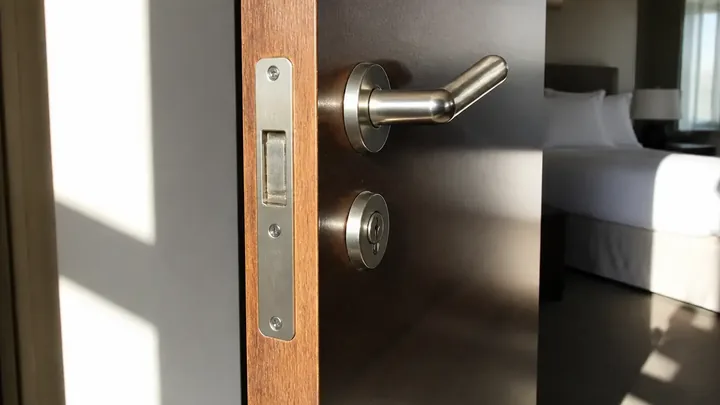
Electronic lock failures announce themselves in front-desk traffic. Rekey lines and “my key stopped working” complaints cluster on failing units before the units fail outright, which makes the front desk log an inspection instrument if anyone reads it by room number. In the room, the standard is mechanical: the handle returns crisply under spring power, the latch throws fully, the unit sits tight on the door with no rock under a two-hand twist, and the battery-warning behavior (however your hardware signals it) is on the engineering calendar, not discovered by a guest at 11 p.m. Interior face: the privacy function operable one-handed at guest height.
Frame, threshold, and the floor transition
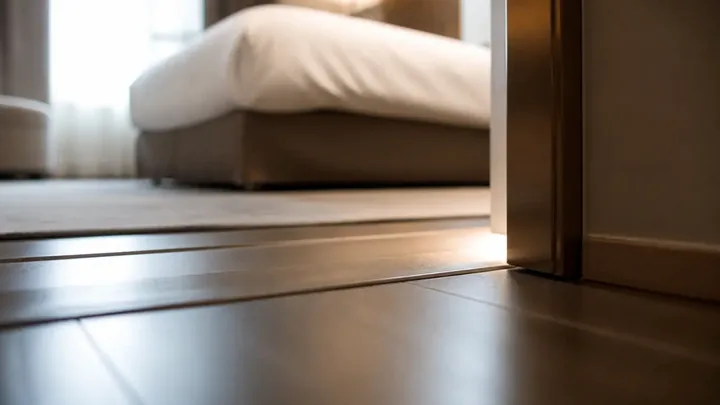
The threshold is the zone’s trip line and its wear line at once. Wheeled luggage concentrates impact on the threshold and the first stride of flooring; the standard is a transition flush or beveled, tight to the floor on both sides, with no lifted edge that catches a shoe or a wheel. A metal transition strip with a raised corner is an act-now finding: it is at ankle height, in the dark, in the path of every guest. The frame itself takes the luggage-cart hits: split casing at cart height, crushed weatherstrip, paint burnish that photographs badly. Kneel once: the zone’s worst wear is below knee height and invisible from standing, which is true of the room generally and truest here.
The first-impression strip
Stand where the guest stands at first entry, bags still in hand. Inventory what is actually in the sightline: the entry light quality (the switch falls under the hand at the door, and it lights the path, not just an accent), the first run of flooring (the entry strip soils and crushes first in the whole room. It is the natural first candidate in any soft-goods planning conversation), the wall corners (outside corners at the entry take cart and luggage strikes; corner guards that match the wall read as intentional, damaged corners read as neglect), and the door’s interior face, which holds the fire-evacuation notice and the room’s most-read signage: current, legible, framed straight. None of these lines cost real money. Collectively they are the guest’s baseline calibration for everything the room does after. A crisp entry buys forgiveness, a shabby one converts every later flaw into a pattern.
The entry zone is the one place where the honest inspection starts outside the room: walk the last twenty feet of corridor as part of the zone, because the guest does. The corridor-side door face, the frame, the latch-side jamb where cards get forced, the room number plaque: that is the actual first impression, and it belongs to the same standard even though it technically lives in public-area territory.
The acoustic seal
The entry door is also the room’s largest acoustic component, and its seals do double duty. The same gasketing and door bottom that block corridor light are most of what stands between the guest and every corridor conversation, ice run, and luggage wheel of the night. The daytime proxy checks are quick: gasket compression intact around the full perimeter (a gasket crushed flat seals nothing), the door bottom or sweep actually contacting the threshold, and the light-leak reading that the night walk performs from inside a dark room, since light and sound leak through the same gaps. Rooms opposite elevators, ice machines, and service doors carry the load hardest and deserve the first pass of any gasket-renewal sweep: a cheap, floor-at-a-time project that shows up directly in the “could hear everything” review line, which no amount of interior refresh ever answers.
Like every seal finding in this manual, log gasket failures by mode and location: crushed versus torn versus missing, latch side versus hinge side versus bottom. A floor whose gaskets fail at one spot is telling you about a door alignment or closer-force pattern, and the fix belongs one level up from the gasket order.
Failure modes and their triage
| Finding | Bucket | Why |
|---|---|---|
| Door fails to self-close and latch | Act now | Fire rating and security both defeated |
| Secondary security device loose or missing | Act now | Security component that fails under load |
| Raised threshold edge or lifted transition | Act now | Trip line in the dark path |
| Closer slams; adjustable | Work order | Noise plus cumulative hinge/frame damage |
| Frame splits, corner strikes, entry-strip crush | Ledger | Wear-rate evidence for the capital file |
| Interior signage faded or missing | Work order | Compliance and legibility, cheap fix |
The pattern to watch at the ledger level is rate. Entry zones across a floor failing the same way at the same age are a specification lesson for the next cycle (a harder transition detail, corner protection, a darker entry-strip colorway). The audit that counts instances instead of collecting anecdotes is what turns the lesson into a spec line. The entry zone will never be the expensive zone. It is merely the one every guest grades first, twice a day, with their hands full.