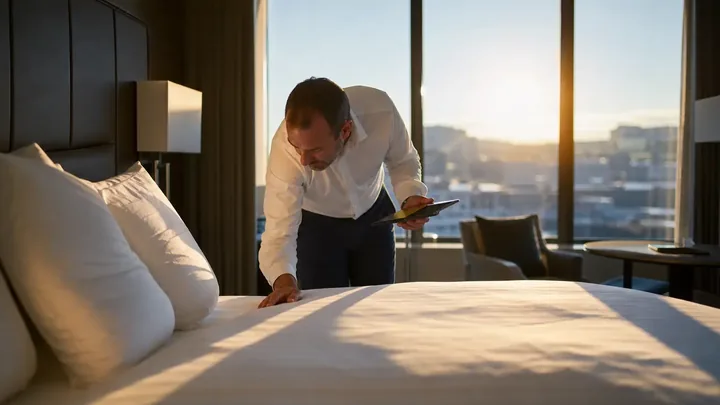
If you walk rooms for a living, you eventually notice something that no spreadsheet told you: guest rooms do not age randomly. Across property types, price points, and climates, the same sequence shows up again and again. The soft goods go first. The casegoods go second, and they go at their edges before their surfaces. And the bathroom runs on a separate clock entirely: quieter, slower, and far more expensive when it finally rings.
To be clear about what this is: an observed pattern, not a dataset. Nobody has published a controlled study of ten thousand rooms aging in laboratory conditions, and any specific numbers you see attached to this sequence are someone's estimate dressed up. But the order itself is one of the most reliable things in this business, and it is reliable for reasons you can explain from first principles. Once you can explain it, you can budget against it.
The mechanism: contact frequency times forgiveness
Everything in a guest room sits somewhere on two axes. The first is contact frequency: how many times per stay a guest's body, luggage, or belongings touch the thing. The second is forgiveness: how gracefully the material absorbs that contact before it shows. Wear is what happens where high contact meets low forgiveness, and the aging order of a room is just that multiplication table read out loud.
A duvet cover is touched for hours every night and is made of fabric: maximum contact, and a material that shows every wash cycle. A dresser top hosts a suitcase a few times per stay and is sealed wood or laminate: moderate contact, high forgiveness, until the day the seal is breached. Tile grout is stepped on constantly but fails chemically and hygroscopically rather than visibly, so it degrades for years in silence. Same room, three different clocks.
First to fail: the soft goods
Bedding, upholstery, carpet, and window treatments lead the decline, and inside that group there is a sub-order worth knowing:
- Top-of-bed and bath linen wear on the laundry cycle as much as the guest cycle. Every wash is a withdrawal. They are also the cheapest to replace and the fastest to make a room feel renewed, which is why they are the perennial first move of a mid-cycle refresh.
- Upholstered seating fails at its arms and its front edge, the two places hands and calves land, and it fails visibly, because soil and abrasion concentrate exactly where the eye lands when a guest decides whether to sit down. A lounge chair with clean cushions and grimy arms reads as dirty even the morning after it was shampooed.
- Carpet doesn't wear evenly; it wears in lanes. Door to bed, bed to bathroom. The lane compacts and ugly-outs while the field under the window stays showroom-fresh, which is why a carpet can be simultaneously "fine" by square footage and finished as a product.
- Drapery ages mechanically before it ages visually. Carriers, cords, and wands fail from daily full-travel operation while the fabric still looks acceptable. Guests report this as a broken room, not a tired one.
The strategic point: soft goods are the room's sacrificial layer. They absorb the most contact, they show it first, and they are the only layer you can realistically replace without touching the building. A refresh strategy that ignores this, that lets the sacrificial layer run to failure on the same schedule as the durable layers, wastes the one cheap move the sequence offers you.
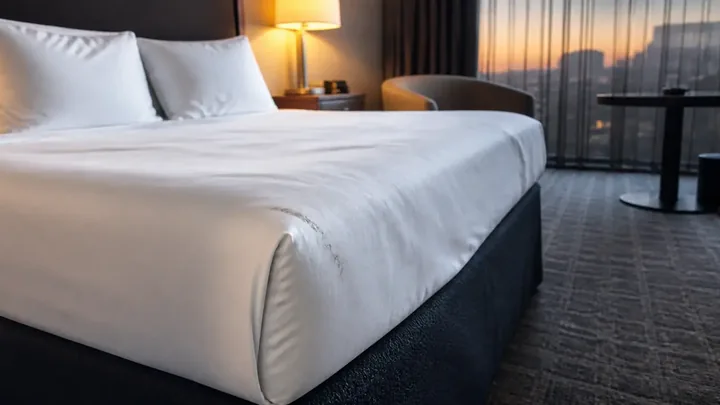
Second: casegoods, edges first
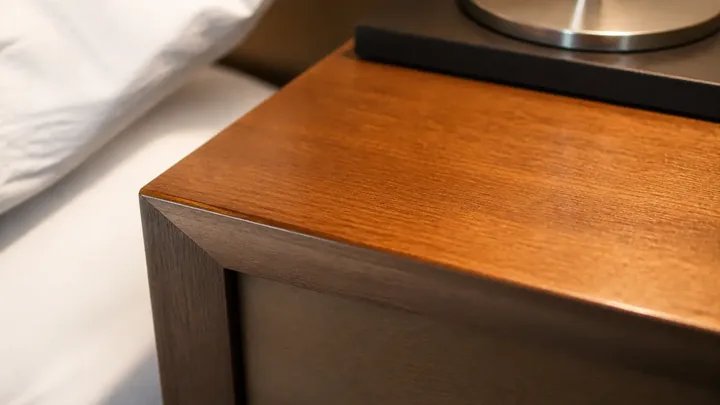
Dressers, desks, nightstands, and headboards decline in a pattern so consistent you can inspect for it blind. It is not the tops that go first. It is the edges and the moving parts:
- Edge banding at the desk and dresser front, where belt buckles, luggage, and vacuum heads strike. Once the band lifts, moisture gets under it and the failure accelerates; a lifted edge is not a cosmetic state, it's the beginning of a structural one.
- Drawer glides and pulls, which are cycled by every guest and serviced by no one. A drawer that racks or a pull that spins reads as neglect to a guest even when every surface is perfect.
- Vertical faces at floor level (kick zones on the bed base, nightstand legs, the dresser's bottom rail) scarred by vacuums and luggage wheels. Invisible from standing height, obvious the moment you kneel. This is a flashlight-and-knees finding, which is why it goes unlogged for years on properties without a real room walk.
- Tops last, and usually by chemistry rather than impact: cleaning-agent haze, cup rings where a finish was already thin, sun fade on the piece nearest the window.
Casegoods hold their function long after they lose their finish, which makes them the layer where "worn" and "broken" diverge most. A scarred desk still works. This is exactly why casegoods are where deferral concentrates, and why rooms in year twelve of a seven-year plan all share the same look: acceptable bed, acceptable art, and furniture that announces the real age of the room from the doorway. The wear tells the truth the soft goods were replaced to hide.
Kneel in the entry and shine a light across the room at shin height. Everything that layer of the room has been hit by in five years is recorded there. It is the most honest elevation in the building.
Third clock: the bathroom, quiet then expensive
The bathroom does not follow the soft-goods-then-casegoods parade; it runs its own program. Its materials (tile, stone, porcelain, glass, chrome) are the most durable in the room, so it looks fine the longest. But its failure modes are cumulative and concealed:
- Caulk and grout fail continuously from day one. Caulk is a maintenance consumable with a service life measured in a couple of years, but it is almost never treated as one; it is treated as a thing to be fixed after it visibly fails, by which time water has been traveling behind it for months.
- Sealed surfaces fail invisibly. Stone loses its seal, glaze wears off high-use tile, and the surfaces begin absorbing rather than shedding. The room starts to hold odors and stains that housekeeping can no longer remove, and everyone blames housekeeping.
- Fixtures fail by generation. A fifteen-year-old bathroom with perfect tile is still fifteen years old at the valve, the fan, and the drain. These are the components whose failure takes the room out of order. The wear was never the risk; the water is.
This is why bathroom logic dominates full-renovation math. Soft goods are an expense; casegoods are a purchase; the bathroom is construction. The order of visible aging (fabric, then furniture, then bath) is exactly inverted from the order of replacement cost, and the whole craft of lifecycle planning lives inside that inversion.
What the order buys you
Knowing the sequence converts it from trivia to strategy:
- Inspect where the clock is fastest. Weight your walks toward soft-goods condition and casegood edges; audit the bathroom's hidden systems on a calendar, not on complaint.
- Budget in layers, not in rooms. The room is not one asset aging at one rate; it is three asset classes on three clocks. Fund the sacrificial layer often and cheaply, the casegoods layer on a planned cycle, and the bathroom layer as capital construction with a long runway. (How flags formalize this is its own subject. See renovation cycles.)
- Read a room's true age from the slowest layer. New carpet over original casegoods over an original bathroom is a specific and common disguise. Owners buying properties, and asset managers auditing them, learn to date the room from the drawer glide and the caulk line, not from the bedspread.
The sequence isn't a law of physics, and hard use, water events, or a bad product spec can scramble it in any given room. But as a default assumption it will be right far more often than it is wrong, and a budget built on it will bend where the room actually bends. Rooms tell you how they're going to fail. They tell you in order. The only question is whether anyone on the property is writing it down.