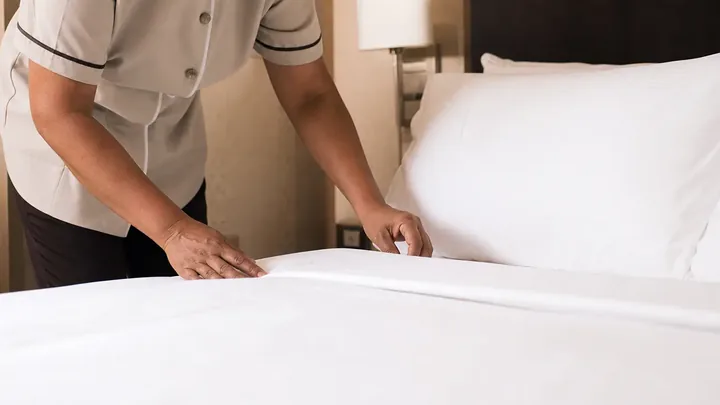
Most room inspections are not inspections. They are visits. A manager steps into a guest room, sweeps their eyes across it the way a guest would for the first three seconds, decides it looks fine, and leaves. Nothing was touched, nothing was opened, nothing was written down, and the room got credit for passing a test it was never actually given.
A room walk is different. A room walk is a fixed path, walked the same way every time, with your hands on the product and a light in your hand. It exists for one reason: rooms hide their failures from standing eye height in the doorway. The wobble in the nightstand doesn't announce itself. The delaminating edge on the desk faces the wall. The caulk line behind the tub spout has been growing something for a month. You find these by touching things in a set order, or you don't find them at all. A guest does.
Why a fixed path beats a sharp eye
The instinct is to believe that inspection quality comes from experience: that a twenty-year GM simply sees more. Experience helps, but it is not the mechanism. The mechanism is sequence. A fixed path does three things a sharp eye cannot:
- It removes the choice of where to look. Attention is a budget. If you decide, room by room, what to check, you will unconsciously check what was wrong last time and skip what has never been wrong yet. The path spends the budget for you, evenly, every time.
- It makes the walk teachable. "Develop an eye for it" is not a training plan. "Start at the door, end at the tub, in this order, touching these twelve things" is. Your AGM can learn a path in a week. They cannot inherit your instincts in a decade.
- It makes results comparable. If every room gets the same walk, a room that generates three findings is genuinely worse than a room that generates one. If every room gets a different glance, your notes are anecdotes.
The path itself matters less than its fixedness, but a good default runs with the guest's own flow and ends in the wettest, most failure-prone space: door → entry and closet → bed → nightstands and lighting → desk and seating → window wall → TV and casegoods → bathroom, finishing at the tub or shower. Ending in the bathroom is deliberate. It is where the most expensive surprises live, and if you're rushed, better to rush the drapes than the grout.
The kit: what you carry and why
You can walk a room with nothing, but you'll find more with four things that fit in one hand or one pocket:
- A flashlight. Not your phone. A real light, held at a low angle. Raking light across a casegood top, a headboard, or a bathroom floor reveals scratches, film, and grout failure that overhead lighting is specifically designed to flatter away. This is the single highest-value tool in the building.
- A white cloth. Wipe the top of the picture frame, the back of the bathroom door, the top rail of the headboard. The cloth doesn't lie and doesn't negotiate.
- Something to write with: a printed sheet or a phone, but the notes must land somewhere that survives the day. A finding that lives only in your memory is a finding that dies by lunch. Use the printable room-walk checklist if you don't already have a form.
- Your own weight. Sit on the bed at the corner. Sit in the desk chair and lean. Pull on the closet rod. Open every drawer to the stop. Furniture fails under load, and you are the only load in the room that reports back.
The flashlight test for a "clean" bathroom floor: kill the overheads, put the beam flat along the tile from the doorway, and look for the halo of residue around the toilet base and along the tub. Housekeeping is usually cleaning fine. It's the checker who's been approving in bad light.

The touch points, in order
The full sheet is longer, but these are the stations that earn their place on every walk, with the failure each one exists to catch:
| Station | Action | What it catches |
|---|---|---|
| Entry door | Close it from inside; work the latch, deadbolt, and swing bar | Strike misalignment, failing closer, the security hardware guests actually rely on |
| Closet | Inspect the rod installation per its instructions; run the door through normal full travel | Loose rod anchors and doors off track |
| Bed | Sit at the corner; lift the skirt and light up the frame | Broken slats and center supports, debris and belongings under the bed |
| Nightstands | Rock them with one hand; open the drawer to its stop; switch every lamp | Loose legs and glides, dead bulbs and dead outlets guests report as "the room is broken" |
| Desk & task chair | Sit and lean back; run your palm along the desk's front edge | Failing chair cylinders and casters; edge-band delamination that snags sleeves |
| Window wall | Run drapes through full travel; check blackout overlap; work the lock | Broken carriers, light gaps that generate 5 a.m. complaints, latch failures |
| Casegoods & TV | Rake light across tops; push against tall pieces; check anchoring | Finish wear, and tall furniture that moves when it should not (see worn vs. unsafe) |
| Bathroom | Run water hot; flush and hold; light along caulk and grout lines; pull the grab bar and towel bars hard | Slow drains, failing caulk, loose bars: the room's real liability center |
Every station is a hand action, not an eye action. That is the discipline. If your hands stayed in your pockets, you visited the room; you didn't walk it.
Cadence: which rooms, how often
Nobody walks every room every day, and pretending otherwise guarantees the program dies in a month. Set a cadence you will actually keep. A workable structure for a full-service property or a lean select-service team:
- Daily: a small fixed number of rooms, enough to cover the house in a rolling cycle over a few weeks. Pull them from a list, not from convenience, or the rooms near the elevator get walked forever and the far corner of the top floor never does.
- Always, same day: any room coming off out-of-order status, any room that generated a comfort or maintenance complaint, and any room a guest was moved out of. These rooms have told you something is wrong; the walk confirms whether it was fixed or merely reset.
- Periodically, deeper: a slower audit-grade pass with scoring, which is a different document. See writing a room-condition audit.
Rotate who walks. The GM's path, the AGM's path, and the chief engineer's path should be the same path, and the fastest way to verify that is to walk one room together each week and compare findings. Where two walkers disagree, the path gains a clarification. That is the system improving.
Writing it down: the finding, not the feeling
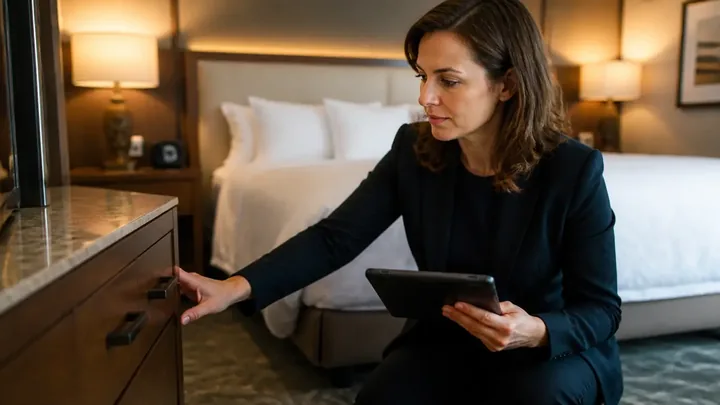
A walk that produces "room 412 looking tired" has produced nothing. A finding needs three parts: location, condition, action. "412: desk front edge, edge band lifting 6 inches on the left. Engineering to re-glue or band, this week." The first version is a mood. The second version is a work order.
Findings split into two streams, and the split is the whole point of the program:
- Today stream: anything a guest could be hurt by or that kills a sellable room. This bypasses the list and becomes a work order before you leave the floor.
- Ledger stream: wear findings (finish, fabric, soft goods) that accumulate into your capital case. Individually they are not urgent. Collectively they are the evidence file that funds your next refresh, and the walk is where the file gets built. An owner hears "the rooms feel dated" and shrugs; an owner reads ninety dated, located, specific findings and reaches for the reserve study.
Making it survive you
The room walk fails as a personality and survives as a routine. Three habits keep it alive when you're off property:
- Put the path on paper. One page, stations in order, hand actions named. Laminate it. New AGM orientation includes walking three rooms against the sheet with someone who knows it.
- Review the ledger monthly. Ten minutes with the accumulated findings, sorted by room type and by element. Patterns appear fast. The same drawer glide failing in twenty rooms is not twenty findings, it's one product decision.
- Close the loop visibly. Walkers stop reporting what never gets fixed. When a finding becomes a completed work order, it should be marked against the original note. The walk feeds the fix; the fix feeds the walker's willingness to keep looking.
None of this is glamorous, which is exactly why it works. The properties whose rooms hold up are not the ones with the sharpest-eyed GM. They are the ones where the same boring path gets walked with a flashlight, in the same order, by whoever is on duty, long after the person who designed the path has moved on.