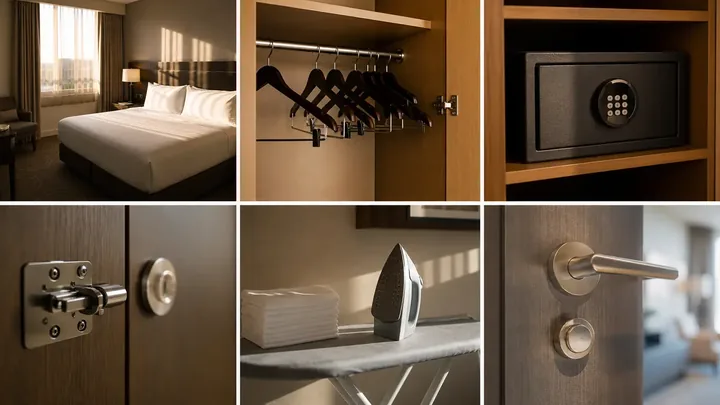
No zone in the guest room carries more mechanical load per square foot than the closet, and no zone gets less inspection attention. It is dark, it is behind a door, and nothing in it photographs for the renovation brochure. But walk the failure reports honestly and the closet earns its place in the fixed path: rods pull out of walls, sliding doors derail onto feet, safes eat passports the night before flights, and irons scorch or leak onto whatever a guest owns that needed pressing. Every one of those is a preventable finding with a hand check attached. This is the zone standard.
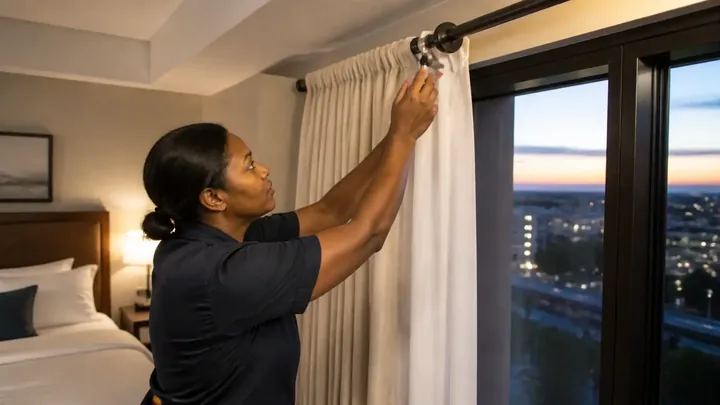
The rod: inspect the installation and function
The closet rod is the zone’s structural component. In service it carries a wet garment bag, a leaned suitcase, and occasionally a chin-up from a traveling teenager, and its failure mode is not gradual sag but anchor pull-out, all at once, onto whatever is below. Inspect visually for looseness, deflection, damaged brackets, or substrate movement and verify capacity only by the manufacturer’s or qualified installer’s method; do not improvise a body-weight load test. Observed movement at an anchor is an act-now finding: a component whose next failure drops load on a guest is never a ledger item. While your hand is up there, sight the shelf above the rod. It takes the same abuse with the same anchors and holds the spare bedding at head height.
Doors: full travel, every visit
Closet doors fail at their extremes, which is why the check is full travel, both directions, every walk. A door cracked to peek tells you nothing. Sliding and bypass doors: on their track through the whole run, no derail at the ends, no scream, bottom guides present (the missing bottom guide is the classic pre-derail state. The door works until the day it exits the track onto someone’s foot). Bifolds: pivots seated, no sag-and-scrape arc on the floor. Mirrored doors get one check the others don’t: edge condition. Chipped or cracked mirror glass at door height is act-now. It is glass, in a hand zone, under movement. Hinged doors are the easy case: swing, catch, and the inside face, which guests see and inspectors don’t.

The safe
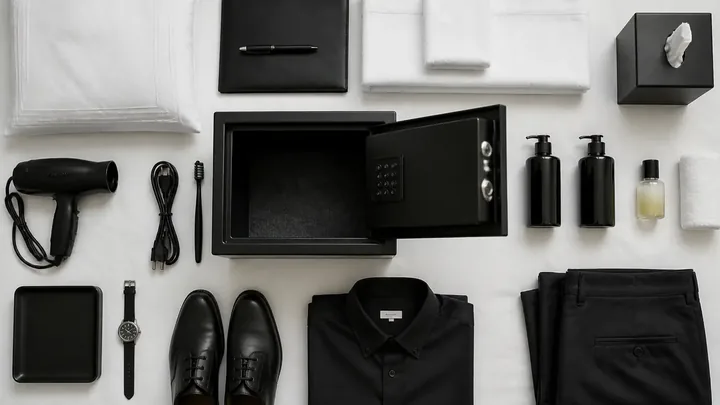
The in-room safe earns two distinct lines. Mounting: a safe is a security component only while it is installed as specified. Inspect the mounting and verify it by the manufacturer’s or installer’s method; a safe with observed movement is an act-now finding, since an unbolted safe is a carrying case with a keypad. Service state: door opens and closes on test code, battery status on the engineering calendar rather than discovered by a guest at checkout with a flight in three hours, and the override/audit procedure documented, current, and (this is the part that fails in practice) known to whoever is on the desk at 2 a.m., because that is when safes get opened under distress. A dead safe at midnight is a service incident; a dead safe plus an unfindable override key is a review, a refund, and occasionally a missed flight with the property’s name on it.
The iron, the board, and the amenity shelf
Small components, outsized failure surface, because they are the only appliances in the room a guest operates against their own clothing. The iron: soleplate clean, scorch residue on the plate transfers to the next garment it touches, which converts a two-dollar cleaning problem into a guest’s ruined shirt; reservoir empty (a stored iron holding stale water spits rust); cord jacket intact at both strain points, since a frayed iron cord is an electrical finding, act now. The board: pad and cover unscorched and tight, a scorched cover transfers exactly like a dirty soleplate; legs lock positively so the board does not fold under press pressure. Hangers: count against the property’s stated standard, and note the split between open hooks and security loops. Whatever the standard is, the walk verifies it, because hanger drift is the quietest theft-and-attrition line in the room. Luggage rack: straps unfrayed, legs tight, feet padded: it exists to keep suitcases off the furniture and the bed, so a broken one is not a missing amenity, it is load displaced onto components that cost fifty times more.
The closet is where room-to-room inconsistency shows first, because its contents walk: hangers migrate, irons get swapped by housekeeping mid-shift, luggage racks wander to the room that had a rollaway. Once a quarter, audit the closet inventory across a floor against the standard in one pass. It is twenty minutes, and it is the difference between a stated room standard and a rumor of one.
Failure modes and their triage
| Finding | Bucket | Why |
|---|---|---|
| Rod or shelf moves at an anchor under firm pull | Act now | Next failure drops load on a guest |
| Mirrored door chipped or cracked | Act now | Glass, hand zone, under movement |
| Frayed iron cord | Act now | Electrical; the room sells without an iron, not with that one |
| Safe shifts under a pull | Act now | An unbolted safe is a carrying case |
| Door off track, missing bottom guide | Work order | Pre-derail state; cheap part, foot-level failure |
| Scorched board cover, dirty soleplate | Work order | Transfers to guest clothing; pennies to fix |
| Hanger count below standard, rack straps fraying | Ledger + inventory note | Attrition pattern; feeds the quarterly count |
The zone’s closing note is about light: a dark closet defeats every standard in this document, because guests and inspectors alike cannot grade what they cannot see. Where the closet has a fixture, it rides the lamping schedule like any other; where it depends on room light, the walk checks that the door-open sightline actually receives it. The automatic-switch closet light, where the building has it, gets cycled on every walk. It is the one fixture whose failure no guest will ever report, because none of them know it was supposed to work.
As everywhere in this manual, the table’s buckets assume the walk actually happens: every line above is invisible from the doorway with the closet shut, which is the zone’s whole diagnostic problem and the reason the fixed path opens every door it passes, every time, hands on.
Reading the zone at ledger level
Closet components are cheap individually, which is exactly why they get deferred into embarrassment. No single derailed door ever justifies a capital line. The ledger fixes the frame: counted across the floor, closet findings move as a cohort (tracks, guides, and pivots age on one clock when they were installed in one project), so the honest planning unit is the floor-wide hardware refresh riding along with the next soft-goods turn, not thirty separate work orders spread over two years of guest-reported failures. The two exceptions run the other way and faster: anything anchored (rod, shelf, safe) and anything glass or electrical (mirror doors, iron cords) are act-now findings the day they move, chip, or fray. The closet may be the room’s cheapest zone, but its failures land on guests from above, at foot level, and through their own clothes, and that is the only expensive kind.