
Every other zone in the guest room supports the transaction; the bed is the transaction. A guest will forgive a scuffed desk and a dated lamp with barely a note. The same guest scores a squeaking frame, a sagging mattress, or a stained blanket as a failure of the entire property, because the bed is the one component they are explicitly paying for and the one they spend a third of their stay in contact with. That asymmetry is the whole logic of this zone standard: bed-zone findings are graded against a harder curve, triaged faster, and budgeted with less argument than anything else in the room.
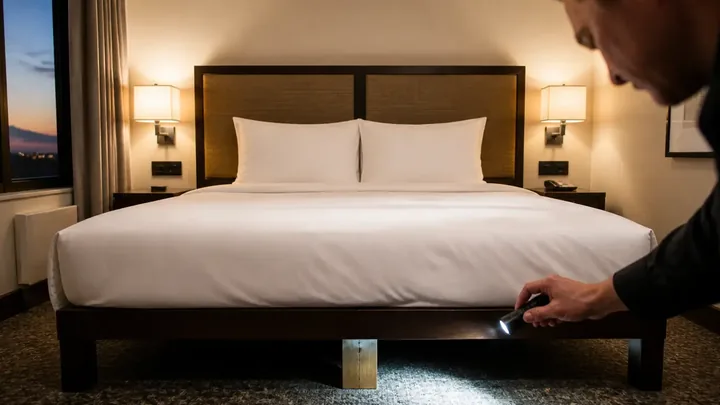
The frame and its center support
The frame’s job is silence under moving load, and the check has to supply the moving load. Sit on the corner of the bed, shift your weight, listen and feel. A frame that speaks under one inspector will shout under two occupants. Then lift the skirt and put the flashlight underneath, because the under-bed is where the zone actually fails: slats seated in their hangers, the center support leg present, vertical, and bearing on the floor (the migrated or missing center leg is the single most common cause of the “saggy bed” complaint that gets blamed on a healthy mattress), casters or glides intact so the bed is not walking under use and chewing the carpet, and no debris, no left-behind belongings, no dust state that indicts the cleaning cycle. Platform bases: check the deck for cracks at the corners. A frame finding is a work order, not a ledger line: frames are repairable the day they are found and complaint generators every night they are not.
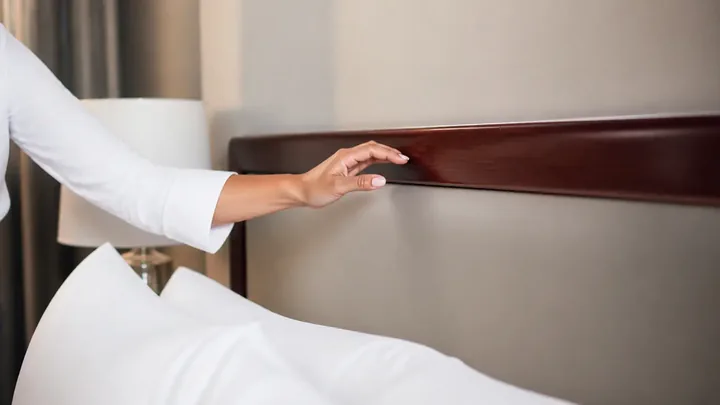
The headboard
Identify how this headboard is attached before choosing an inspection method. Keep the model, mounting arrangement, installation instructions and responsible installer in the room-type record. A wall-mounted panel, a bed-attached headboard and a freestanding assembly can have different fixing details; use the instructions applicable to the installed product.
During the room walk, look for displaced panels, visible gaps, damaged fittings, missing fasteners or changes reported by guests and staff. Do not invent a force, hard pull or proof-load test. Verify attachment only by the method specified by the manufacturer, anchor supplier, qualified installer or responsible safety professional. The CPSC’s Anchor It guidance directs users to the anchoring kit’s instructions and distinguishes attachment methods by wall construction. It is a useful reason to retain installation details, not a hotel-specific inspection-force specification. CPSC Anchor It installation guidance
If movement is observed during normal use or an authorized check fails, record the room number, affected component, photographs and the circumstances. Apply the property’s isolation and room-status procedure, then assign the repair to someone qualified for that system. A work order should identify the remedy and the return-to-service verification, not simply say “tightened.”
For a repeated room type, inspect the records for the rest of the installation cohort when one fixing problem appears. That review can establish whether the defect is isolated or whether a broader inspection is needed. It does not justify assuming every room has the same fault or applying the same repair without checking.
Because the headboard is the largest single decorative surface in the room at eye level from the pillow, its finish belongs in the wear ledger with photographs: head oils and contact wear on upholstered panels, halo soiling around the perimeter, chipped rails on wood units. Upholstered headboard condition moves with the soft-goods clock and belongs in that conversation at refresh time, not as a standalone surprise.
The mattress set
The mattress is inspected in three layers, and the discipline is to actually open the bed . A made bed inspects nothing.
- Surface. Strip to the mattress (or to the encasement). Staining, and the honest question of which side of the encasement it is on; seam and border integrity; the handles and tags intact. Any evidence of pests is an act-now, room-out-of-service finding . That protocol outranks this document and every schedule in the building.
- Structure. Body impressions that persist visibly, edge collapse under a firm sit at the border (edge support fails first and guests sit on edges), and the lie-down test where doubt exists: thirty seconds flat on the bed tells you what no visual inspection can. Persistent sag with a healthy frame under it is a replacement conversation, not a rotation one.
- Program evidence. If the property runs mattress rotation, the evidence should be visible: rotation tags or logs current, encasements actually zipped rather than draped, protectors laundered on cycle. An encasement unzipped at three corners is spend without protection, worse than no program, because it reports as one.
Top of bed
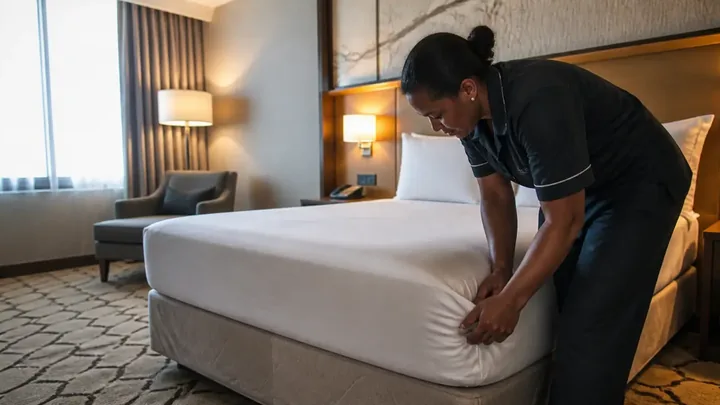
Top of bed is the zone’s visible skin and the room’s single most photographed surface. The standard: every layer stain-free and press-crisp (triage-fail linens leave with today’s strip, which is a laundry-standard question more than an inspection one); decorative layers (runners, throw pillows) cleaned on a written cycle, because decorative pieces that are never laundered are the open secret guests already suspect; duvet inserts and pillows lofted, not pancaked (a flat pillow is a replacement item on a consumable clock measured in months, and pillow budget is the cheapest guest-satisfaction money in the building); bed skirt hanging straight with no drag, no tears at the platform corners. Count pillows against the stated standard by type, like closet inventory, top-of-bed contents walk.
Make one bed yourself per quarter, per housekeeper you supervise, alongside them. Nothing audits the top-of-bed standard (layer order, tuck depth, pillow spec, what the inside of that duvet cover actually looks like) like being inside the process. And nothing communicates that housekeeping is the asset-preservation department faster than a GM with a fitted sheet in hand.
Reading the zone as cohorts
The zone fails in cohorts, and the ledger should be read that way. Every component in the bed zone was typically installed in one project. Frames installed together loosen together: the first squeak complaint is rarely alone, and a frame-tightening sweep of the whole floor (an afternoon with a wrench, scheduled the week the second complaint lands) is cheaper than a year of room-by-room callbacks. Mattresses bought together age together, which is what makes the trigger list workable: units retire individually on evidence, but the purchasing conversation is a cohort conversation, and the audit’s job is to say whether the cohort’s failures are the leading edge of a wave or genuine outliers. Headboard cleats, top-of-bed textiles, and bedside lamping follow the same logic on their own clocks. Reading the zone this way also settles the classic misdiagnosis chains before they spend money: the “sagging mattress” that is actually a missing center leg, the “noisy frame” that is actually a headboard cleat, the “worn out bed” that is a flat pillow cohort, each cheap to fix and expensive to mis-solve, and each distinguishable in ninety seconds by the hand checks above. The zone’s findings are never just the room’s; they are the floor’s, on a delay.
The cohort lens is also what makes the zone’s budget conversations short. A frame sweep is an afternoon; a pillow cohort is petty cash; a mattress cohort is a reserve line with a date on it, and all three are visible a year out to any ledger that counts findings by component. The zone that carries the product claim should never be the zone that surprises the budget, and read as cohorts, it isn’t.
Why this zone is triaged on a harder curve
Run the same finding through two zones and watch the triage shift. Finish wear on a dresser edge is a ledger line for the annual audit; comparable wear on a headboard at pillow height is a this-quarter conversation. A wobbly desk chair is a work order; a wobbly bed frame is a tonight work order. The asymmetry is rational: the bed zone converts directly to review language (“the bed” appears in guest reviews with a frequency no desk ever earns), it carries the property’s core product claim, and its failures are experienced for eight continuous hours rather than in passing. Budget season should reflect the same curve: when the deferral pressure arrives, as it does every year, the bed zone is the wrong place to send it. Defer the artwork. Nobody ever wrote a review about the artwork.