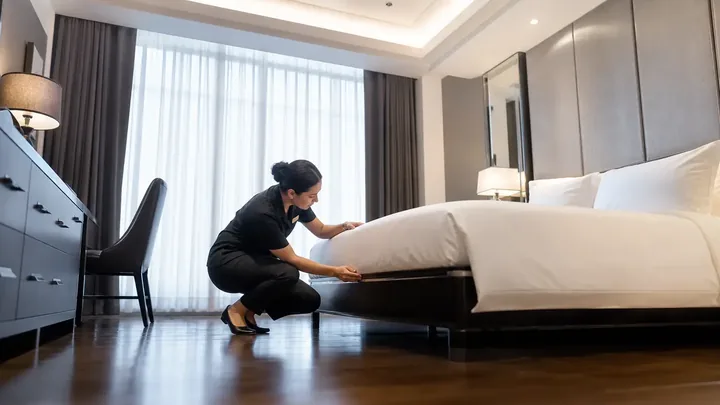
Ask who is responsible for how long the guest-room furniture lasts and you will hear about procurement specs, brand cycles, and capital budgets. All true, all secondary. The largest single influence on FF&E lifespan after the purchase decision is the team that touches every surface in every room every single day: housekeeping. A room attendant interacts with the desk, the casegoods, the upholstery, and the bath finishes hundreds of times for every one time an engineer or a GM does. Whatever they do to those surfaces, good or bad, is applied at a frequency no other department can match.
Most properties run housekeeping purely as a cleanliness-and-productivity function and treat asset condition as someone else's outcome. That is a structural mistake. The same labor, pointed slightly differently, is an asset-preservation program you are already paying for.
Chemistry: the slowest vandalism in the building
Nothing ages finishes faster than the wrong product applied daily with the best intentions. The mechanisms are mundane and relentless:
- Aggressive cleaners on sealed wood and laminate haze and soften finishes one wipe at a time. The desk that looks "worn" in year four may in fact be chemically stripped. Abrasion had nothing to do with it.
- Acidic or abrasive products on stone and grout etch surfaces and eat the very seal that was protecting them, converting a shedding surface into an absorbing one. From that day forward the bathroom gets harder to clean, which invites harsher chemistry, which is the whole failure loop in one sentence.
- Disinfectants left to dwell on metal hardware and upholstery corrode plating and break down fabric backings. Dwell time that is correct for sanitation on a toilet seat is wrong for a lamp switch or a chair arm.
- The unlabeled spray bottle, the industry's oldest hazard, is also an asset hazard: nobody can use the right product from a bottle nobody can identify. It is an OSHA hazard-communication problem first (every workplace chemical must be identified and its hazards communicated: see OSHA's hazard communication page), and an FF&E problem the same minute.
The fix is unglamorous: a short approved-product list, one product per surface class, dispensed and labeled properly, with the forbidden combinations stated out loud in training, not buried in an SDS binder. When a surface fights back against the approved product, the answer is a report upward, not a stronger bottle from the janitor's closet.
Technique: how rooms get cleaned matters as much as with what
Watch a room being serviced with an asset manager's eye and the lifespan levers are all visible inside fifteen minutes:
- The vacuum is a bumper car. Vacuum heads and wand hardware strike casegood kick zones, bed bases, and table legs on every pass. The shin-height scarring that dates a room's casegoods is substantially a vacuum signature. Technique training, and picking machines sized for the actual clearances of the actual room, is cheaper than refinishing.
- Dragging versus lifting. A nightstand dragged to retrieve a guest's dropped charger loosens its joints and scars the floor; the same move done a thousand times is a furniture rebuild. The rule that seating and casegoods are lifted or walked by two people, never dragged one-handed, is a lifespan policy disguised as a body-mechanics policy, and it is a legitimate body-mechanics policy too.
- Linen technique touches the bed frame. Corner-slamming a heavy mattress during changes works the frame and headboard fasteners loose over months. Mattress rotation done on schedule, and done by two people so it is done at all, evens wear on the single most guest-felt asset in the room.
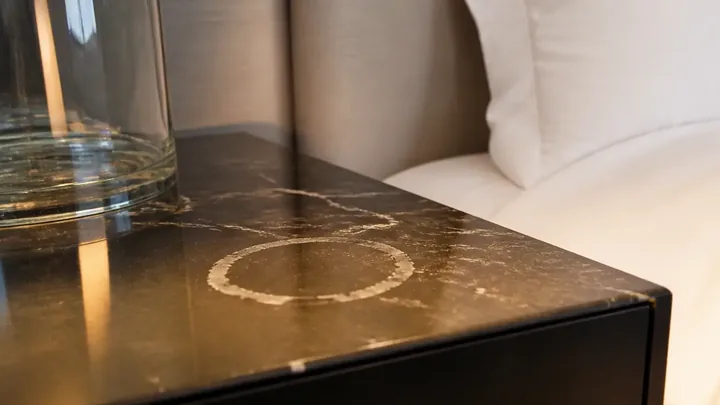
- The caddy has a parking spot. Caddies and chemical bottles set on casegood tops and upholstered seats leave rings, scratches, and bleach kisses. "The caddy lives on the cart or the bathroom floor, never on the furniture" is a one-line standard with a decade-long payoff.
Audit the actual cart, not the manual. Ten minutes with one cart tells you what your finishes are being exposed to: what's in the unlabeled bottle, which "temporary" abrasive pad became permanent, whose personal miracle product rode in from home. The cart is the ground truth of your chemical program.
The sensor network you already employ
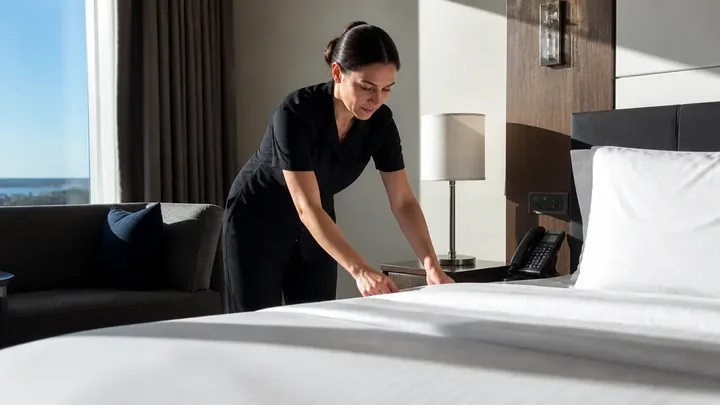
No inspection program, not even a disciplined room walk, observes the rooms at housekeeping's frequency. Attendants see the loose headboard bolt, the drawer that racks, the first inch of lifted edge band, and the damp smell behind the vanity days or weeks before any manager will. The property's real question is whether that information has anywhere to go.
Most places, it does not. Reporting is verbally discouraged by pure logistics: the attendant is on a room count, the finding requires a radio call or an app they weren't trained on, and nothing visible ever comes of it. The reporting culture is built, or killed, by three design choices:
- Make the report cheaper than silence. One motion: a checkbox column on the assignment sheet, a photo to a house channel, a tag left on the knob. If reporting costs more than thirty seconds, the count wins and the finding dies.
- Never punish the messenger with the workload. If reporting a broken glide means the attendant is somehow delayed, blamed, or asked to work around it forever, the lesson is learned instantly and permanently. Findings route to engineering; the reporter's job ends at the report.
- Close the loop in public. The single strongest signal is the attendant seeing last week's report fixed. Read a few fixed items back at the morning huddle by name: "the 6th-floor drapery wands Maria flagged are all replaced." Thirty seconds, and it recruits sensors faster than any memo.
Deep cleans: preservation's scheduled hours
The periodic deep clean is where housekeeping most directly buys asset life. It is the only time the room's protective maintenance actually happens: upholstery extraction before soil becomes abrasion, mattress rotation, high-dusting that keeps grit out of hardware, grout care that keeps the harsh-chemistry loop from starting. Two management failures routinely gut it. First, deep cleans are the schedule's shock absorber: the first thing sacrificed to a sold-out week and never rescheduled. Second, they are unscoped: "deep clean" means whatever there is time for. The countermeasure for both is the same: a written per-room scope with a checklist, and deep-clean rooms blocked like out-of-order rooms so the time actually exists. A deep clean that reliably happens is worth more than an ambitious one that reliably does not.
Training that survives turnover
Housekeeping turnover is a structural fact, which means any preservation practice that lives in a veteran's habits is a practice on a countdown. The material has to be built for the department you actually staff: visual, physical, and short. A one-page surface-and-product card on every cart beats a chapter in an orientation binder nobody rereads. The three or four furniture-handling rules (lift don't drag, the caddy's parking spot, the vacuum's clearances, two people for mattresses) are demonstrated in a real room during onboarding, not described in a conference room. And supervisors inspect for technique occasionally, not just for results: a spotless room serviced by dragging the nightstand is a passing grade today and a refinishing bill in year three. None of this is elaborate. It only has to be repeatable by the next crew, and the one after that, because they are coming either way.
The reframe
None of this asks housekeeping to work harder. It asks management to notice what the department already is: the highest-frequency inspection force and the highest-frequency wear force in the building, simultaneously. Point the chemistry at the right surfaces, coach the handful of techniques that scar furniture, give findings a thirty-second path upward, and defend the deep-clean calendar. Every one of those moves is paid for out of budget you are already spending, and their combined effect shows up years later as the quiet, unglamorous difference between a room that made its cycle and a room that needed rescue two years early.