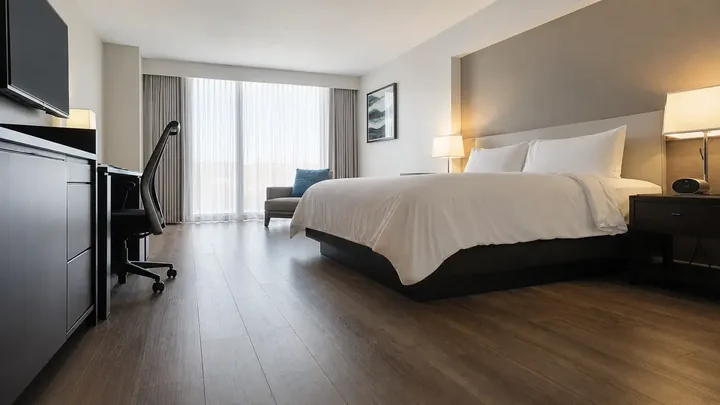
Every property claims a deep-clean program. Walk the evidence (pull a bed from the wall, open a sleeper, lift a mattress, run a finger along the top of the wardrobe) and a large fraction of those claims collapse on contact. The deep clean is the most paper-vulnerable program in the operation because it has no daily constituency: no guest books a deep clean, no shift depends on it, and its absence is invisible for a year and then permanent. A real program survives on three disciplines: a scope written against the turn’s known blind spots, a schedule that treats deep cleans as inventory events, and verification that distinguishes a completed room from a signed form. This document covers all three, and then the fourth discipline: keeping the program alive through budget season.
Scope: the inverse of the turn
The deep clean’s scope is not “the turn, but harder.” It is the complement of the turn: everything the thirty-minute choreography structurally cannot reach, which means the scope can be written mechanically by walking the turn’s limits:
- Everything behind and under: bed pulled, furniture moved, the entry and perimeter carpet lines vacuumed where the daily machine never goes, the under-bed cleared and cleaned.
- Everything that opens: sleepers opened and cleaned inside, drawers emptied and wiped, closet shelving cleared.
- Everything requiring dwell or saturation: carpet extraction, upholstery extraction on its rotation, descaling done properly with label-honest contact times, grout renewal where scheduled.
- Everything above shoulder and below knee: high dust, crown and ledge lines, exhaust grilles degreased, baseboards, kick zones.
- The rotations that ride along: mattress rotation and encasement inspection, duvet and pillow-protector laundering, shower-curtain or glass treatment, lamp and fixture interiors.
The printable companion, GRS-C-04, carries this scope room by room. The scope document lists tasks per zone with the standard of done for each, and it names what the deep clean is not: it is not a repair visit. Mechanical findings it surfaces route through the work-order handshake; a deep-clean crew with a screwdriver produces untracked repairs and unfinished cleans.
Scheduling: inventory events, not overtime
The program’s standard death is scheduling it as slack work, “when occupancy allows,” because occupancy never formally allows, and the program starves politely. The working alternative treats the deep clean as an inventory event with the same standing as maintenance blocks: each room carries a due date on a declared frequency (the industry’s conventions run from quarterly to twice yearly depending on occupancy and product tier. Declare yours and let the evidence argue it up or down), rooms come out of sellable inventory for the hours the scope requires, and the rotation is published weeks ahead so the desk sells around it rather than cannibalizing it nightly. Sequence by room-level logic, not convenience: highest-occupancy rooms first (they accrue shadow-zone load fastest), returning OOO rooms get theirs at the return gate, and the rotation’s laggards, the rooms repeatedly skipped, are the report the executive housekeeper reads weekly, because skip patterns are how the paper program is reborn.

Verification: rooms, not forms
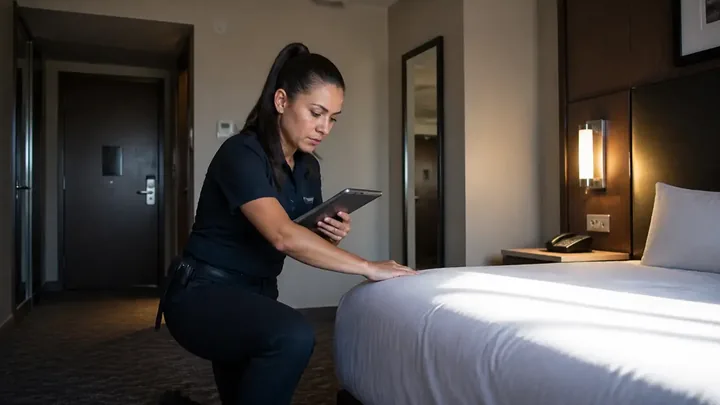
A deep-clean signature verifies that a form was signed. The program verifies rooms: a sampled inspection (some fraction of each week’s completed rooms, walked within days by a supervisor or by the standing inspection rotation) against the scope’s standard of done, checking precisely the low-visibility items the signature is most tempted to round up on: the under-bed, the sleeper interior, the grille, the mattress rotation tag. Two design notes keep verification honest. Sample unpredictably. A known sample schedule is a scope-reduction memo. And feed results back as calibration, not ambush: crews shown photographs of what “done” means converge on it exactly the way inspectors converge on anchors.
Date-tag the invisible work. A small dated sticker inside the sleeper mechanism, under the mattress corner, inside the vent grille frame, marking the last deep-clean date where only staff and inspectors ever see it, converts “was this room really done in March?” from an argument into a glance, for the cost of a label. It is the housekeeping equivalent of the photo that survives arguments.
Sizing the crew and the calendar
The program’s arithmetic should be run once, on paper, before any schedule is promised. Rooms, times frequency per year, gives deep cleans per year; divided by realistic working days, gives rooms per day; times the scope’s honest crew-hours per room, gives the labor line. Run honestly, the numbers usually surprise in one direction (the program is smaller than feared, a manageable daily trickle rather than a seasonal siege) and the arithmetic exposes the two classic sizing errors. The first is the task-force model: saving the program for a low-season blitz, which produces rooms deep-cleaned eleven months ago on average, concentrates the inventory hit into the one period the property could be doing capital work, and builds a crew that does the scope twelve days a year and is expert at none of it. The steady-trickle model (one dedicated pair, or a rotating assignment with real training, working the due-date list continuously) keeps the average room’s last deep clean recent, the skill current, and the inventory cost invisible. The second error is borrowing the labor back: the deep-clean pair absorbed into daily turns every time occupancy spikes, which converts the program to paper at exactly the occupancy levels that age rooms fastest. The defense is the same as for any program in this manual : the calendar is published, the due-date list is reviewed weekly, and skips require a name, a reason, and a new date, not a shrug.
Pair the calendar with engineering’s where the geometry allows: a room already out of inventory for preventive maintenance is half the deep clean’s cost already paid, and the two programs walking the same room in the same window catch each other’s findings: the cleaner who finds the loose headboard, the technician who notes the matted grille. The combined visit is not always practical, but the shared due-date list costs nothing and routinely saves the inventory hit of a second out-of-service day.
Defending the program
The deep-clean program is proposed for the knife every lean budget year. It is labor-heavy, invisible, and its absence costs nothing this quarter, which makes it the perfect deferral candidate. The defense is the same evidence architecture the rest of this manual runs on. The program’s cost is knowable: rooms times frequency times crew-hours. Its yield is written in the ledger, in the only currency budgets respect: extraction dates against carpet condition grades, encasement compliance against mattress replacement age, grille service against moisture findings. The audit of a property with a live program reads measurably younger than its install dates, and that difference is the program’s receipt. Put it next to the deferral arithmetic and the conversation shortens: cutting deep cleaning does not save the labor, it converts the labor into early capital at an unfavorable exchange rate. The program is not a cleaning luxury. It is clock maintenance, the cheapest way a property buys back months on every soft-goods clock it owns, and it should be defended, in budget season, as exactly that.