A close-up of a desk edge can show a lifted strip clearly and still leave the maintenance team unable to act. Which desk is it? Which room? Was the image taken before or after the repair? The photograph needs a record that answers those questions.
Use this method for routine room findings and maintenance comparisons. The condition audit defines the scope and scoring; this guide explains how to capture, connect and retrieve the images supporting a finding. A clear photo record can support a discussion with a supplier or contractor. It does not guarantee claim acceptance or establish a photograph's legal status.
Give the finding an identity before filing the images
Create one finding ID in the property's work-order or condition system. Link it to the room, the particular item or surface, the observed condition, observer and observation time. Keep the proposed action in a separate field so a later decision does not rewrite what was originally seen.
Describe the condition literally. “Desk front-left edge: strip lifting away from the substrate” is more useful than “bad desk.” If the cause is unknown, leave it unknown. A picture of swelling does not by itself establish which spill, cleaning method or leak caused it.
Take context and detail that belong together
Start with a view showing the whole piece and its position in the room. Then move closer to show the finding clearly. If the detail cannot be located from the wide view, add an intermediate view rather than leaving the reader to guess. Use the same finding ID for the whole set.
Include a ruler or suitable measuring tool when size affects the decision, with its units visible and near the surface being measured. Record the measurement in the finding as well. Do not infer an exact dimension from an unidentified object or from a perspective-distorted photograph. Where placing a scale would disturb the condition or create a hazard, record that limitation and use another appropriate method.
Check the images before leaving. The important area should be in focus, with enough surrounding detail to identify it. Take another frame if a reflection, shadow or your hand obscures it. More photographs of the same unclear angle do not resolve the missing information.
Show how the lighting affects the finding
Make a normal room-light view useful first. For surface texture or wear that is difficult to see, an additional low-angle light view can help describe it. Identify that additional lighting in the caption so a later comparison is made under similar conditions. Avoid letting a bright reflection cover the exact area being discussed.
When a mark appears only under a particular light or angle, say so. Do not turn that view into a claim about what every guest sees. Equally, a wide shot that conceals a defect does not cancel a clear detail view. The set should explain the condition and the viewing circumstances together.
Photograph only from a safe position. Do not load a suspect chair, pull an anchoring point or repeat a hazardous failure to make a better image. Report and restrict the affected item through the property's procedure; worn versus unsafe covers the triage decision.
Keep the original and label the working copy
Transfer the original files through the property's approved workflow and keep them alongside the finding record. If the system compresses or converts uploads, establish where the originals will be retained. A screenshot or a forwarded messaging-app image may be useful for a quick conversation, but it should not become the only version the property keeps.
Use a copy for arrows, circles, cropping or a presentation layout. Label it as an annotated or cropped copy and link it back to the original. Do not paint out objects, alter the apparent condition or overwrite the original with the version prepared for a capital meeting.
NIST's digital-evidence preservation report describes documenting a file's source, protecting its integrity and maintaining backup copies. It also discusses hashes that can help detect file changes. The report is written for evidence handlers; an ordinary hotel photo register is not a forensic examination. The relevant records principle is to keep the original traceable and make later changes distinguishable.
Record observation time separately from upload time. Retain camera metadata where available, but do not treat it as proof of the observation's date or location. If the device clock was wrong, document the known discrepancy and the basis for the observation time without silently replacing the original file. When the date is unknown, say that it is unknown.
Build comparison sets for a specific question
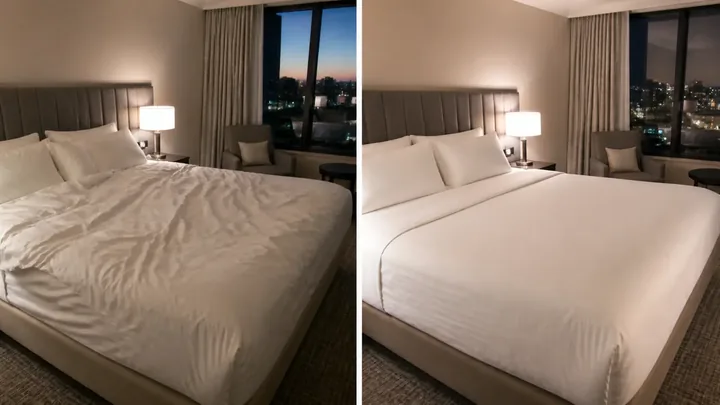
Before-and-after photographs need a defined event: delivery, a contractor's work, cleaning, repair or a later inspection. Name the event and connect the two sets to the same room and item. Repeat the viewpoint, framing and lighting where practical. Record differences that affect the comparison, such as a moved piece or changed room lighting.
A made bed and an unmade bed demonstrate a change in presentation. They do not establish furniture deterioration or prove that a repair restored a mechanism. Decide what the comparison needs to show before taking it. A repaired drawer may need the same visible joint or fitting photographed, together with a recorded functional check by the appropriate person.
Keep a brief written outcome beside the new images: work performed, completion date, person who checked it and anything unresolved. Preserve the earlier finding. “After” is a stage in the record, not a reason to delete “before.” Use the inspector calibration guide when the question is whether different observers are applying the same condition standard.
Make the register useful to the next shift
| Record group | What to keep together |
|---|---|
| Finding | Finding ID, room, item, observed condition and observer |
| Timing | Observation time, upload time and any known date limitation |
| Images | Original filenames, context/detail role and annotations linked to originals |
| Follow-up | Work order, supplier correspondence, later images and completion check |
Use a naming convention the property can maintain, with the finding ID connecting the files. A filename can include the room and image role, but do not depend on the filename alone: files may be renamed or exported. Test whether another staff member can retrieve the correct set using the finding ID without access to the photographer's phone.
Control access to the folder and avoid including guests, documents, belongings or personal information that the finding does not require. Follow the property's approved access, retention and incident procedures. If an incident or dispute changes preservation obligations, use the direction of the responsible manager, insurer or adviser; this routine does not supply a universal retention period.
The completed set should let another person locate the item, understand what was observed, distinguish an original from a working copy and see what happened next. If one of those answers is missing, correct the record while the observer and the room are still available.