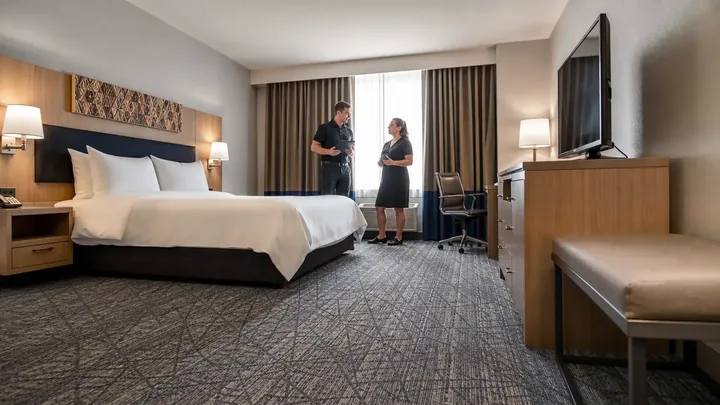
Accessible guest rooms should be designed, reviewed, built, and maintained to the applicable requirements, but neither an as-built condition nor a prior approval should be treated as proof of current compliance. Features can drift out of their approved configuration in service through the ordinary operation of a well-meaning hotel. Nobody decides to make the room non-compliant. A grab bar gets re-mounted an inch off after a tile repair; a replacement showerhead arrives without the hand-held unit; housekeeping stages a luggage bench inside a turning space; a work order swaps lever hardware for the knob that was on the truck. Each event is invisible individually, and their sum is a room that no longer serves the guest it exists for, and no longer meets a legal obligation that does not pause between renovations. The upkeep doctrine treats accessibility as an operating condition to be maintained, exactly like cleanliness, rather than a construction attribute to be assumed.
Scope note, and an important one: this document is about preserving a room’s accessibility features in service. What the features must be (dimensions, counts, configurations) is defined by applicable law, adopted standards, and approved plans. In the US, use the Department of Justice’s 2010 ADA Standards and Title III regulation. Canadian requirements vary by federal, provincial, territorial, and local jurisdiction. Questions of what complies belong to the relevant authority and qualified professionals.
The feature inventory
Upkeep begins the way every safety program begins: with a list. Each accessible room gets a one-page feature inventory built from approved plans, applicable requirements, and qualified field verification (not from the as-built condition alone), covering each relevant element, room by room, because accessible rooms are individually configured: grab bars (locations, orientations), roll-in shower or transfer tub and its seat, hand-held shower unit and its hose, clearances at the bed, the door approaches and turning spaces, door hardware and closer force, peephole and deadbolt heights, closet rod height, safe reach range, visual/tactile alarm devices and notification equipment, counter and switch heights, and the communication kit the property stocks for the room. The inventory is the room’s compliance baseline; with a standard photo set attached, it is also the recovery map after any work in the room.
The drift mechanisms
Knowing how compliance is lost tells you where to stand guard. The recurring mechanisms: repair substitution: the like-for-like rule broken at the parts level (knob for lever, standard showerhead for hand-held, towel bar re-hung where a grab bar was, a heavier closer); re-mounting error: the right part back in the wrong place after tile, drywall, or fixture work, heights and offsets being load-bearing dimensions here; furniture and staging creep: clearances silently consumed by an added bench, a relocated luggage rack, a rollaway stored “temporarily” in the turning space, or renovation-period storage; equipment decay: the shower seat that loosened, the visual alarm device with a dead battery, the pool lift’s cousin problems indoors: accessibility equipment that exists but no longer works; and inventory misuse: the accessible room sold as a last-sell general room and gradually re-staged for that duty. Every one of these is an ordinary operational event; that is the point. Compliance is not lost in renovations. It is lost on Tuesdays.
The two operating rules
Two rules, written into the systems that already run the property, address common drift at the source. The preserve-the-approved-feature rule, enforced at the work order: any work order in a room flagged accessible carries the flag through to engineering and the parts shelf. Repairs preserve the required performance and approved configuration. “Like for like” appearance alone does not prove compliance, and any substitution is reviewed against the approved plans, applicable standard, and manufacturer instructions. (Attic stock earns its keep here twice over: holding the lever sets, hand-held units, and matched grab bars that make the right repair as convenient as the wrong one.) The clearance rule, enforced at staging: the room-set standard for each accessible room shows the furniture plan with clearances marked, the turn resets to that plan, and nothing is stored in required clear space. Properties should audit their own practice; this publication has no dataset showing how often that rule is broken.
The verification pass
The inspection program carries the rest. Accessible rooms ride the standard walk like any room, plus a feature pass against the inventory: grab bars are inspected and tested only by an approved method (observed movement or a failed specified inspection is escalated immediately, and room status follows the property’s approved accessibility and safety procedure); the hand-held unit present, hosed, and holding in its cradle positions; the shower seat inspected or tested according to its instructions; door hardware and closer performance checked with an appropriate method rather than informal hand feel; clearances walked against the plan; equipment powered and tested on its schedule; and the communication kit inventoried where stocked. The pass adds minutes, not hours, and its findings are logged against the feature inventory so the room’s compliance history is a document. The audit treats accessible-feature lines as their own category with the shortest correction windows in the ledger.
Train the flag, not just the specialists: everyone who touches rooms (housekeeping, engineering, front desk moving inventory) should know which rooms are accessible and that those rooms have one extra rule: nothing changes in here without the inventory being consulted. Most drift is committed by people who did not know they were in a special room. The flag in the systems, and one line of training, is the cheapest compliance control that exists.
The equipment closet and the booking promise
Two adjacent disciplines complete the program. The equipment closet: the portable accessibility equipment the property lends (shower chairs, raised seats, visual-notification kits, whatever the property has committed to stock) is a program of its own, with an inventory, a working-condition check on a calendar, a cleaning protocol between loans, and a named storage location the night desk can actually find; a lending list the property cannot fulfill at 10 p.m. is a promise in the same failed state as a blocked turning space. And the booking promise: the accessible room’s features exist for the guest who reserved them, which makes inventory integrity part of upkeep. In covered US lodging, the reservation process must identify accessible features, hold accessible rooms until other rooms of that type are rented, block a reserved accessible room, and apply the same reservation guarantee to the specific accessible room to the extent other reservations are guaranteed. The front desk should know what its features are well enough to answer the phone question honestly. Both disciplines are operations rather than construction, both are cheap, and both fail the same way the physical features fail: quietly, on a Tuesday, in front of exactly the guest with the least room to absorb it.
Why upkeep is the whole game
The legal exposure gets the attention, and it is real. Accessibility obligations are continuous, and a drifted room is a complaint or an inspection away from becoming a legal matter with a documentation demand attached. But the operating case is simpler and closer to home. The guest who booked the accessible room booked it because they need its features to use the room at all. The missing hand-held unit or the blocked turning space is not an inconvenience to them; it is the room failing entirely, discovered at 9 p.m., with luggage, after travel. No other room in the house can fail that completely while looking fine. Upkeep (the inventory, the two rules, the feature pass) is what keeps the room’s promise standing between the renovations that built it. It is among the least expensive programs in this manual, and it is the one whose lapses land hardest on the specific guest least served by an apology.