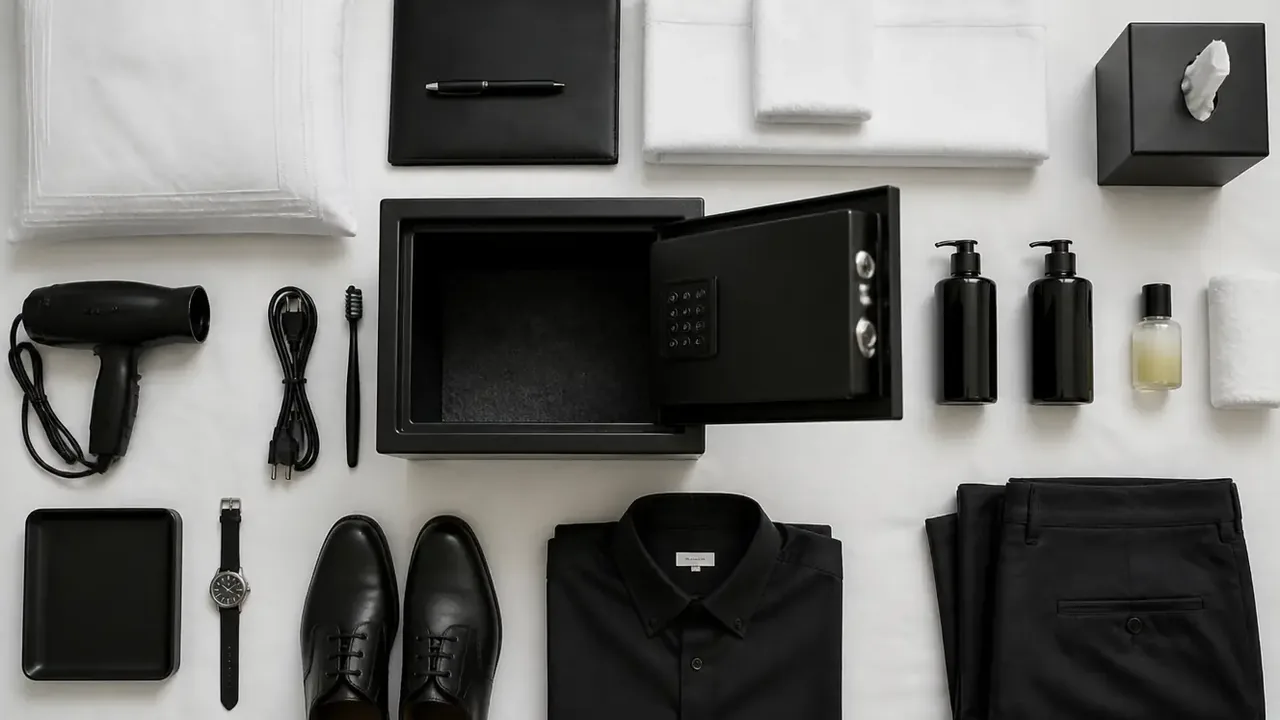
Choose the safe's opening format before fixing the cupboard, shelf or drawer around it. A front-opening safe, a lid-opening safe and a pull-out safe ask the guest to load belongings in different ways. Furniture that fits the closed box can still obstruct the opening or leave the contents difficult to retrieve.
Begin with what the hotel intends guests to store and how they will reach it. Include a representative laptop in its usual case, travel documents and any other items in the property's stated brief. Treat that as a proposed use to verify with the offered safe, rather than promising that a laptop-size label describes every device and case.
Read outside, inside and door dimensions separately
External dimensions locate the safe in the furniture. Internal dimensions describe the space inside. The item still has to pass through the opening and reach that space while the safe is installed.
Vingcard's current linked Elsafe Zenith Standard product sheet, printed in October 2025, keeps these measurements separate. For Zenith Wide it lists outside height, width and depth of 191 by 460 by 417 millimeters, including the keyboard; inside dimensions of 188 by 457 by 345 millimeters; and a separate “door dimensions” entry of 140 by 400 millimeters.
Keep the maker's labels on the comparison. A door-dimension entry needs confirmation of the actual clear opening and any intrusion from the hinges, locking parts or fittings. It should not be silently relabeled as a guaranteed aperture. Obtain a drawing that shows the passage the belongings will use, then review the proposed device and case through that passage with the supplier.
Ask whether internal accessories change the usable space. Use the offered configuration's dimensions rather than subtracting a guessed wall thickness from the outside box or assuming that a stated internal volume is one unobstructed rectangle.
Choose the direction the guest will load it
A front-opening model needs the door to open as instructed, with space to guide belongings through the front. Review its position against the cupboard door and adjacent furniture. The safe door and the furniture door must work together; checking one while the other is removed misses the proposed arrangement.
A top-opening model needs room above the lid and a way to lower items into the interior. A pull-out model needs room in front for the permitted drawer travel and access to its contents. Ask for the exact operating dimensions and method for the proposed product. These are different formats, even when the closed widths look alike.
The maker's Zenith Drawer sheet, also printed in October 2025, distinguishes Top Open 17 from Pull Out. Both have a listed outside width of 460 millimeters, while their listed inside widths are 457 and 410 millimeters respectively. The Top Open 17 inside height is given as a range of 62 to 124 millimeters. Equal outside width therefore does not establish equal usable storage or the same loading movement.
Have the supplier demonstrate the exact offered format with the representative belongings and the proposed furniture arrangement. Review loading, closure and retrieval without forcing a door, drawer or lid. Include the people responsible for guest access requirements in the location decision; a successful fit of the contents alone does not settle reach or operation.
Give the furniture maker the mounting arrangement
Obtain the safe manufacturer's mounting requirements for the offered model and location. Have the responsible installer confirm how the safe is supported and secured in the actual wall or furniture assembly. A shelf drawing that shows only the outside rectangle leaves the attachment unresolved.
Coordinate the safe's fixing locations with the furniture construction and access for installation. Identify who supplies the attachment hardware and who performs the work. Ask the parties to resolve any conflict before the casegoods drawing is released, rather than allowing an installer to choose new holes through finished furniture.
If the safe sits behind another door or within a furniture drawer, identify which component moves and which remains fixed. Confirm the complete arrangement with both manufacturers. Do not assume that a pull-out safe is installed inside an ordinary moving drawer or that every top-opening safe can be mounted in the same way.
Keep the service points reachable
Ask the safe supplier to identify the battery-change and service-access points on the exact product. The Zenith sheets describe external battery changes; that feature still needs accessible space at its location once furniture surrounds the safe. Confirm whether a furniture door, shelf edge or trim piece blocks the intended service method.
Include the hotel team that will commission and support the safe. Obtain its operating information and agree how the hotel's authorized staff receive service training. Keep security credentials and emergency-opening details in the hotel's controlled procedures, rather than putting them on a public furniture drawing.
Where the proposal includes an internal electrical outlet, have the responsible equipment team confirm the permitted use and connection arrangement. An optional outlet listing does not establish that any stored device can be left charging in a closed safe.
Order the housing around the confirmed safe
Release the safe model and the matching furniture drawing together. Keep the external and internal dimensions, confirmed clear opening, full operating movement, support and mounting details, and service-access locations with the order. A later safe substitution needs review of those interfaces even if its outside width is unchanged.
For a coordinated casegoods project, use the hotel furniture inquiry to describe the room quantities, location, timing and safe arrangement. Ask the supplier to confirm whether the required housing can be provided and which safe or installation work needs a separate specialist. The inquiry does not establish availability of the Elsafe examples.
The closet standard covers the installed safe's continuing service state. This order is ready when the chosen format lets the guest put the intended belongings away and retrieve them, while the hotel can install and service the safe through the furniture it is buying.