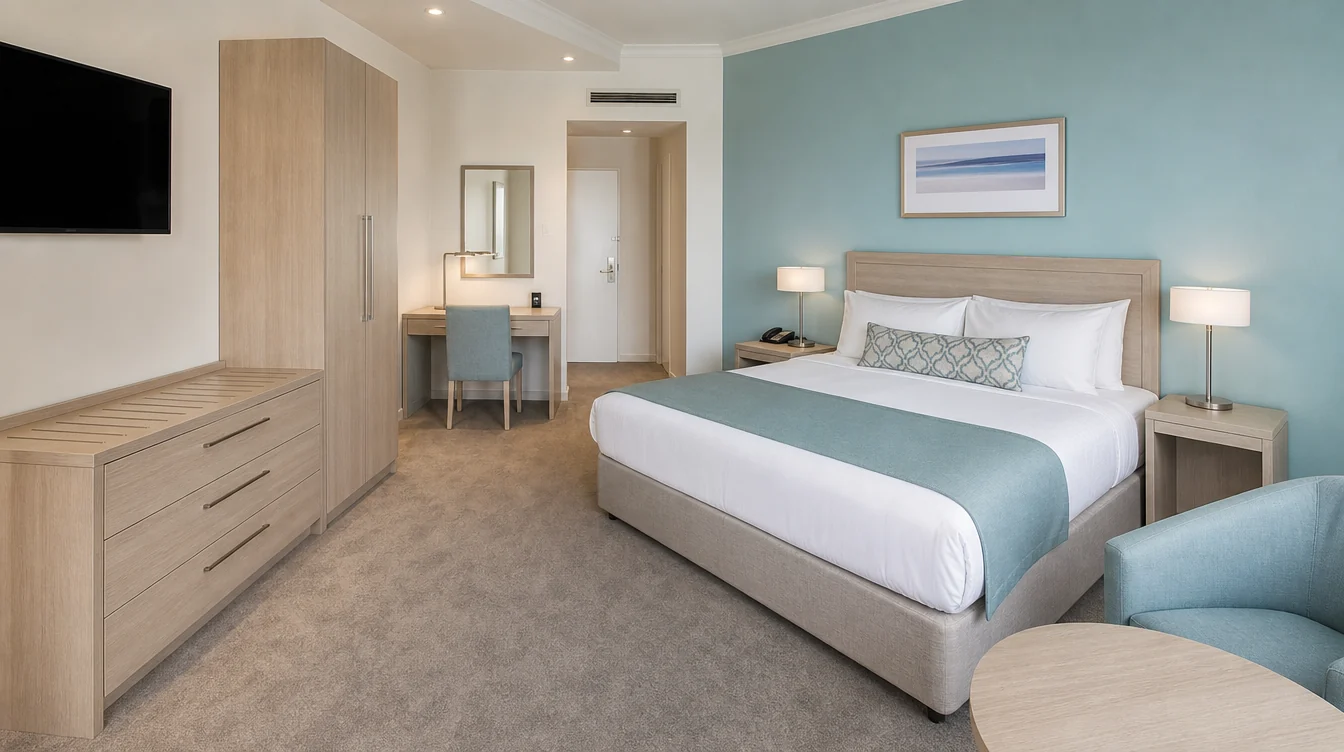
Compare a luggage rack with an open suitcase before adding it to the room package. A closed case can sit neatly on the rack while its opened lid meets the wall, its other half has no intended support or its handle catches on the back bar. The guest needs a place to unpack, not merely a place to park the case.
Decide whether the room will use a movable rack, a fixed luggage surface or both. Keep the desk's working area available for its own job. Then compare the proposed luggage furniture with the actual case types in the hotel's brief and the place each one will be used.
Look at where the case meets the straps
Use a sample or drawing that shows the deployed support area and strap positions. Note which parts of the intended case will sit on that support when closed and open. Overall rack width alone does not show where the load-bearing points of a particular case land.
Forbes Industries' 804EN rack, for example, is described with four poly straps and listed dimensions of 16 inches in length, 24.25 inches in width and 21 inches in height. The maker's 932 wood rack is listed at 18.5 by 24 by 23 inches and has a bumpered back bar. Those are named product dimensions; neither rectangle alone proves that a particular suitcase is supported when open.
Bring representative cases with their usual handles, wheels and opening arrangement. Start by comparing the empty cases with the supplier. Ask the maker for the offered rack's load limit, intended use and any restrictions before placing loaded luggage on it. A product's own weight, carton weight or shipping field is not its load capacity.
For a case that opens into two halves, identify how both halves will sit in the intended use. For a case with an upright lid, check that the lid can reach its useful position without leaning against an unintended surface. Ask the supplier to resolve a support problem through the proposed product or a different luggage surface, rather than improvising extra straps or relying on the wall.
Choose the back bar for the actual room position
A back bar changes the relationship between the case and the wall. On a rack with bumpers, confirm which part is intended to contact the wall and how the case opens relative to it. Check the arrangement with the proposed skirting, wall finish and nearby furniture.
Forbes' steel-rack construction sheet distinguishes versions with and without a bumpered back bar. The presence of that feature should therefore be part of the selected model and drawing, rather than inferred from the rack category. A bumper on the rack does not establish clearance for the suitcase lid, handles or wheels.
Review the rack where the guest will unpack. Leave the open case in the drawing while checking the route to the bathroom, closet and bed with the responsible room team. If the rack must be pulled away from the wall to use the case, show that position too. The room's approved circulation and access requirements still govern the arrangement.
A fixed luggage surface may be the better choice where it provides the intended support and stays clear of the room's routes. Confirm its usable top, load limits and permitted luggage use with the casegoods supplier. Draw the open case on that surface as well; calling a cabinet top a luggage bench does not settle its construction or fit.
Follow the rack into its stored position
If the offered rack folds, obtain the manufacturer's folding instructions and folded dimensions. Ask which parts move, how the rack is held in its stored state and whether anything must be removed before folding. Pivot hardware in a product image does not establish the permitted operating method.
Have housekeeping review how the rack is carried, placed and returned using those instructions. Identify its stored position in the closet or room, including any space it takes from the ironing board, safe or hanging clothes. If it is stored outside the room, name its destination and how staff retrieve it when needed.
Check the position for a second rack where the hotel intends to provide one. Sharing a room does not make the first rack twice as large. Record the quantity for that room type and review both open-luggage positions before repeating the furniture package.
Confirm the care and replacement parts
Ask for care instructions for the exact frame finish, straps, feet and bumpers. Have the cleaning team review the places it needs to reach around the strap attachments and pivots. Get a supplier answer where its normal cleaning products do not match those instructions.
Identify the parts the hotel can obtain and who is authorized to replace them. The Forbes steel-rack sheet describes strap ends attached through metal clips and screws; that is a specific assembly, not a reason to fit any visually similar replacement strap. Have the supplier confirm the correct parts and method for the offered model.
The closet standard already covers continuing rack condition and room inventory. Carry the new model's instructions into that routine once the purchase decision is complete.
Put the accepted luggage arrangement in the order
Record the rack model, deployed and stored dimensions, straps, back-bar and bumper configuration, permitted load and use, and quantity by room type. For a fixed luggage surface, identify the accepted casegoods construction and usable top instead. Keep the open-case position with the room drawing.
Use the hotel furniture inquiry for a rack or luggage-surface requirement within a coordinated guestroom package. Include location, room quantities, the furniture retained and the intended luggage arrangement. Ask the supplier to confirm what it can provide and whether a separate specialist is needed for the selected rack. The inquiry does not establish availability of the Forbes examples.
Choose the rack where the guest can open and use the intended case, and housekeeping can return it as instructed. Where a fixed surface does that job better, make it an explicit furniture requirement before the package is ordered.